Unsubscribe
View in your browser

Diving deep into China's energy transition

Ember Current - October 2026


Muyi Yang

Senior Energy Analyst, Asia

Living in Australia, I notice global energy shocks in a very ordinary place: the petrol station. When diesel prices jump, events thousands of kilometres away suddenly feel very close to home. At the same time, I’m seeing more EVs on the road. High fuel prices give people another reason to make the switch. And EVs are just one example of a much broader move towards electrification worldwide. Of course, electrification doesn’t make energy security challenges disappear. We still need to manage more complex power grids, charging infrastructure and growing electricity demand. But there is a fundamental difference: these are largely challenges we can manage at home. Geopolitics is not. Electrification can therefore reshape energy security by shifting some risks from things we cannot control to things we can.


Insights, analyses and commentaries

My top picks


Lately I've been thinking about what the energy transition really is — and I suspect the answer keeps evolving as we go.
The early phase was about cultivating the technologies and scaling the supply chains. Building clean capacity mattered because it pulled the technology forwards and drove down costs. But much of that work is now done. Solar, wind and batteries are mature and cheap. So the question becomes ‘what comes next’, and I think it's a shift from supply to substitution: rebasing the wider economy on a far more electrified foundation, so clean power can penetrate much deeper into transport, industry and buildings.

China Energy Transition Review 2026

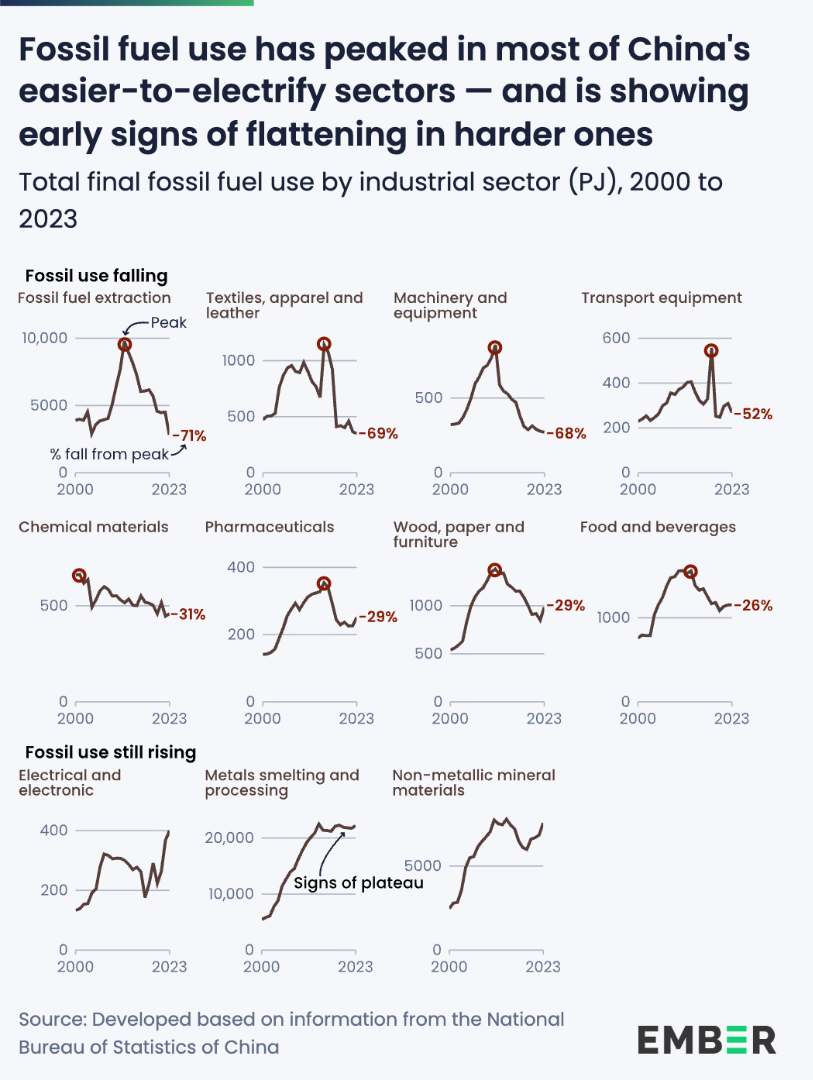
China's energy transition is as complex as its economy, which is why people read it so differently. One camp sees the sheer scale of wind, solar, batteries and EVs and calls it real momentum. The other points to the vast coal fleet and heavy oil and gas use and says clean energy is just being stacked on top of a legacy fossil system. But you can't judge an economy this large from the surface — you have to go deeper. That's what this report does; it looks beneath the national aggregates to show clean electricity has actually started replacing fossil fuels in power generation, system balancing and parts of transport and industry. So if you only read one report on China’s energy transition, I'd start here.

Read the report
 

The Age of Power

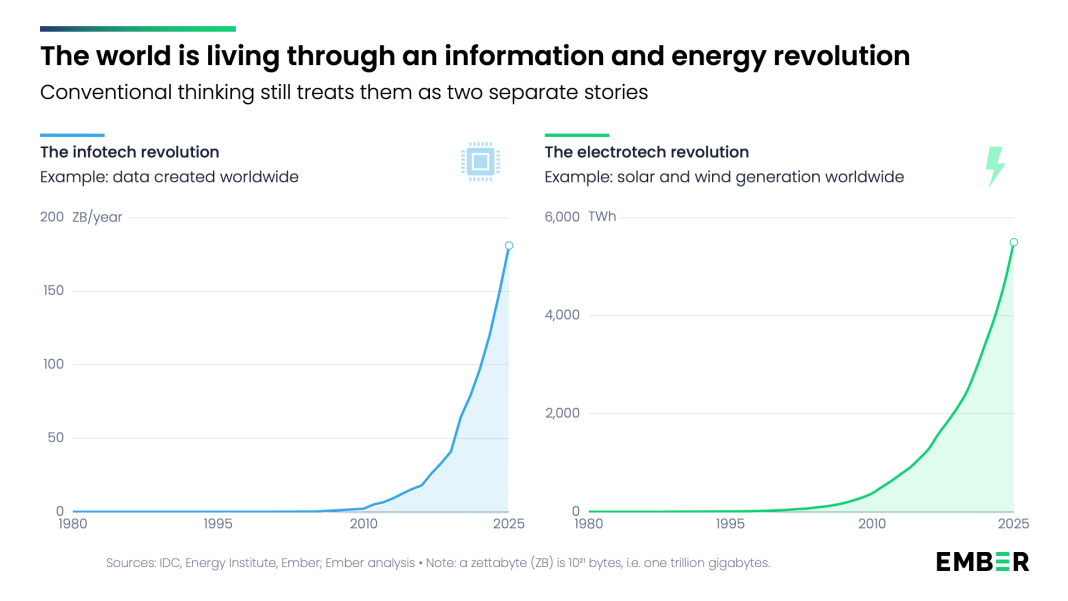
We usually treat the clean energy revolution and the AI revolution as two separate stories. That’s understandable: they’re different industries, different headlines, different worries. This report's argument is that they're really one story – with more in common than you might think. Both revolutions run on the same electrons, share many tech stacks (chips, batteries, power electronics, motors, sensors) and increasingly need each other. AI's limits are becoming electrical — it needs power and grid connections, fast — while a variable, distributed clean grid needs AI-enabled instruments to coordinate it. It's the most compelling case I've seen for why electrifying the economy and scaling AI belong in the same conversation.

Read the report


Ember in the news

  • Why the next industrial race will be won on electricity | Reuters
  • Is China’s Coal Production Growth Finally Slowing Down? – CGTN spoke to Ember’s Biqing Yang | Watch the video
  • 287: Thinking About the Future – The Watt Car EV Podcast episode with Ember’s Euan Graham | Listen here

What I’m reading

  • The Growth Story of the 21st Century: The Economics and Opportunity of Climate Action by Nicholas Stern | Read more
  • The Economic Leap: Crossing the Middle-Technology Trap by Yongnian Zheng and others, in Chinese | Read more

Visual storytelling corner

Chart of the month


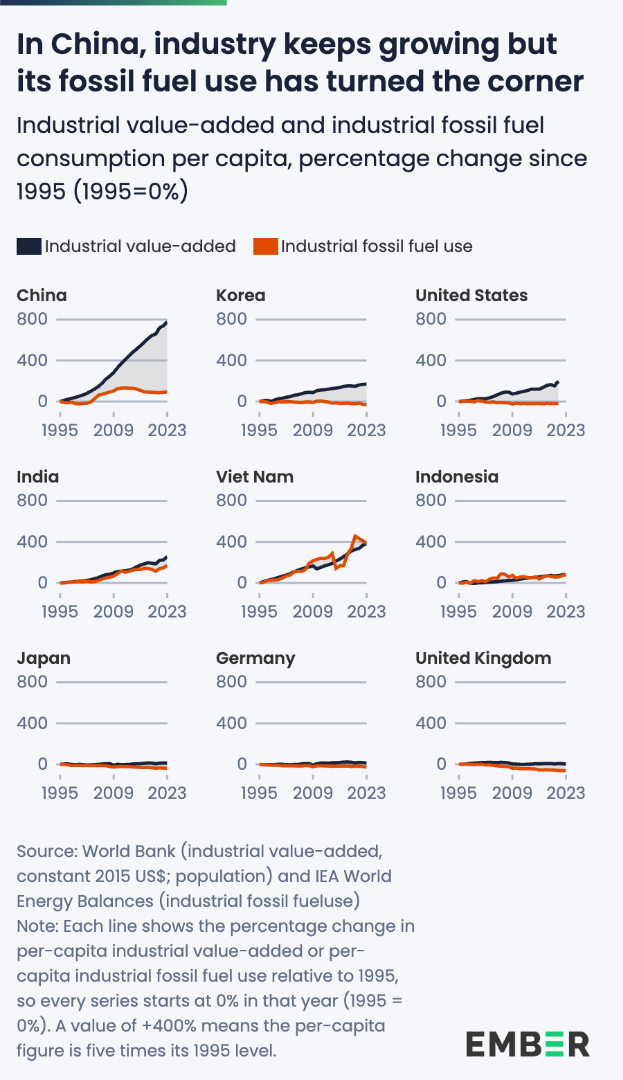
Decoupling is not unique to China. In many developed economies, industrial fossil-fuel use per capita has fallen relative to industrial value-added, but their industrial output has stayed broadly flat. China's trajectory is relevant for developing countries because it has started to decouple while its industry is still expanding quickly. Indexing both series to 1995 puts every country on the same starting line and reveals a pattern of trajectory, not scale. The shaded area between the lines highlights the gap: in China, you can see it widen.

Methane spotlight

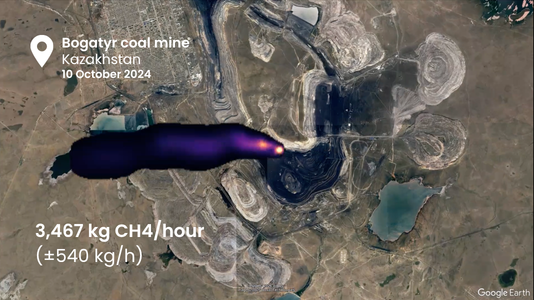
Some methane emissions weren't missed; they were just waiting in the archive. Kazakhstan’s Bogatyr open-pit coal mine – once the Guinness World Record holder for being the world’s single largest coal mine – still produces about 40% of Kazakhstan’s coal. A methane plume detected over this mine shows how new datasets are surfacing emissions that were sitting unnoticed in satellite archives, and why that matters for methane pledges. The plume was always in the data; the information just hadn’t been extracted until now. Retrospective detections like this can correct and gap-fill methane inventories. That means regulators are given an independent, observation-based record to verify reporting against and a baseline to measure progress from. This plume serves as a reminder that open-pit mines, often assumed to be the low-methane end of coal, deserve a closer look.

Watch the video

Turning data into action

Data highlights

DATA TOOL

China Electricity Data Explorer

Coal generation has flattened in 17 of the 26 provincial-level regions tracked in the China Energy Transition Review 2026.


DATA

Africa’s solar deployment is growing faster than international statistics show

Ember’s estimate for installations in 2025 and 2026 is more than double that reported by official sources, with 2026 deployment potentially reaching 17 GW.


Country spotlight

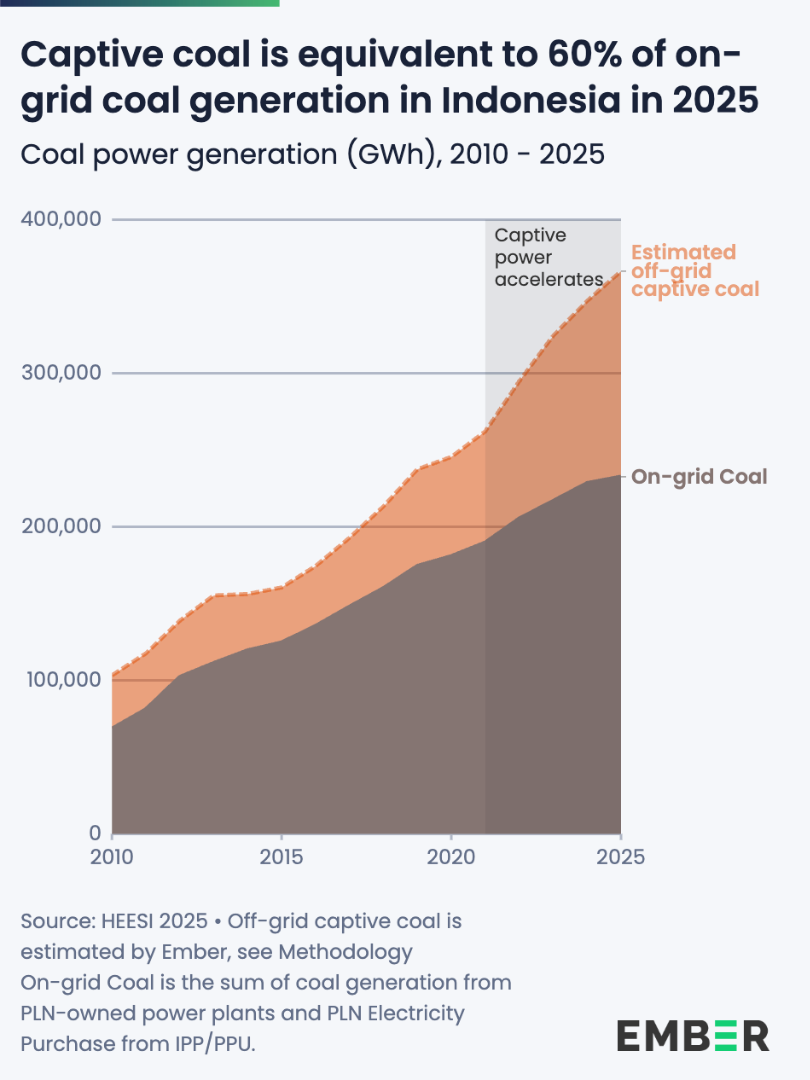
Indonesia has significant captive fossil generation, totalling more than half of on-grid generation, and often goes underreported. Using bottom-up estimates based on industrial outputs, new analysis by Ember on Indonesia brings more comprehensive captive power data into our electricity dataset. The updated Indonesia data is now live in Ember’s Electricity Data Explorer.

Ember is an energy think tank that aims to accelerate the clean energy transition with data and policy. Ember is the trading name of Sandbag Climate Campaign CIC, a Community Interest Company registered in England & Wales #06714443. 'Ember' and 'Sandbag' are trademarks held at the United Kingdom and European Union Intellectual Property Offices. All content is released under a Creative Commons Attribution Licence (CC-BY-4.0). Website powered by 100% renewable electricity.


Unsubscribe or change your communication preferences here

 X / Twitter  Web  Linkedin  Instagram